Showing posts with label Europe. Show all posts

Wednesday, October 5, 2011

From Borghese to Trevi

From a superturbocharged first day, our level of activity slowed down with each passing day we spent in Rome. We became less ambitious with each day's itinerary, hitting the snooze button more times and dawdling longer and longer in our blessedly cool, thick-walled, marble-tiled apartment. 

So by the time our fourth day rolled around, it was nearly lunchtime by the time we set off for Villa Borghese, the sprawling gardens-turned-public park that once belonged to the powerful and wealthy Borghese family. We stopped for lunch at the Piazza del Popolo.


The Galleria Borghese was the "party house" of Scipione Borghese, a nephew of Pope Paul V. Borghese used his wealth and influence to amass a truly stunning collection of art. I was excited to finally see the works of artists I had only seen in books, such as Caravaggio, Titian, Raphael and Rubens.

Tickets for the museum need to be reserved well in advance over the phone. An Italian colleague of Marlon's had helped us call the Galleria Borghese to reserve tickets for that day's 1 to 3pm time slot. The administration is strict and will shoo everyone out after the allotted 2 hours are over.

The Galleria Borghese is simply jawdropping from the first step in. Unfortunately, photography is forbidden—but if it wasn't, I'd be all over it with my camera.


Scipione Borghese was one of the earliest patrons of master sculptor Gianlorenzo Bernini, whose signature is all over Rome. It was in Galleria Borghese that I came face to face with the true genius of Bernini. His Apollo and Daphne is, without exaggeration, the most beautifully sculpted piece of art I've ever seen in my life. I must have spent half an hour just looking at it, and could have easily stayed longer. 

His Pluto and Proserpina in the next room is completely different, but just as captivating.

Photos from the Galleria Borghese website—they simply don't do them justice!

After our museum visit, Marlon and I decided to just take it easy and cool off under the shade of the trees around the Villa Borghese. 


Our curiosity was piqued by the small, funny "tandem bike" buggies that rattled by us every now and then. "That looks like fun!" Marlon said. So we had to give it a try.


The buggies turned out to be electric riscios (rickshaws), that, along with regular bikes, can be rented on an hourly basis. 


Marlon and I rattled around the park for a good 45 minutes or so until we spotted something so tempting, we just had to park our riscio, get down and enjoy it.


A public fountain! After four days of broiling heat and constant walking, I can't tell you what a treat it was to perch on the lip of this fountain and dip my poor footsies into this clear, ice-cold water. It is a miracle of Rome that the water in its fountains is always shockingly cold no matter how hot it gets.


I was obviously not the only one who felt this way. But I just couldn't bring myself to take it to the next level!


Refreshed and rejuvenated, we returned the riscio and headed to the Piazza Spagna, or the famous Spanish Steps, starting all the way at the top for a sweeping view...


... stopping for a photo op, naturally...


... until we ended up all the way at the bottom, with the rest of the 48,000 tourists and their mothers who were there. #mobbed


Everyone was taking photos of this fountain just because it was there, so I did too. #sheep


Just a few streets away was the great granddaddy of all fountains, the Trevi. I didn't expect it to be so... BIG!


The Trevi Fountain was completely mobbed, too. The crowd was overwhelming, so I just found an empty spot to sit down for a while before even taking a single picture. I may have lost count of how many people did the "tossing a coin into the fountain" pose, but I give all them an O for Originality!

Tuesday, October 4, 2011

Silent hill

Palatine Hill, or the Palatino, is the oldest and centermost among the famed seven hills of Rome. In addition to some of the city's first and grandest homes, the Palatino is also where the Roman Forum—the main square around which ancient Rome's public life revolved—were built.

Part of the Palatine Hill and Roman Forum are visible from one of the city's main thoroughfares. After snapping a couple of pictures of this exposed portion, I thought I had seen the Roman Forum. I came thisclose to skipping the whole thing... which would have been highly regrettable.


Marlon and I had also considered doing a quick skip through Palatine Hill after our visit to the Colosseum. It was a good thing we didn't, because wandering through the Palatino eventually took the greater part of an afternoon. 

There's a lot to wander through and absorb. Palatino is where the word palace comes from—because the earliest, truly palatial private residences of the Western world were built here, sort of like a Forbes Park (sige na nga, Upper East Side para sosyal!) of the Roman empire. The homes of the wealthiest and most powerful Romans would be considered impressive even by today's standards.


Much of what we saw on our meanderings were simply the brick understructures, devoid of ornament. Only a few fallen pillars and broken pieces of decoration remain to feed the imagination.


Imagine these walls clad in the purest, most expensive white marble, studded with carvings, mosaics and other minerals. Then imagine a whole hill full of these homes. #class


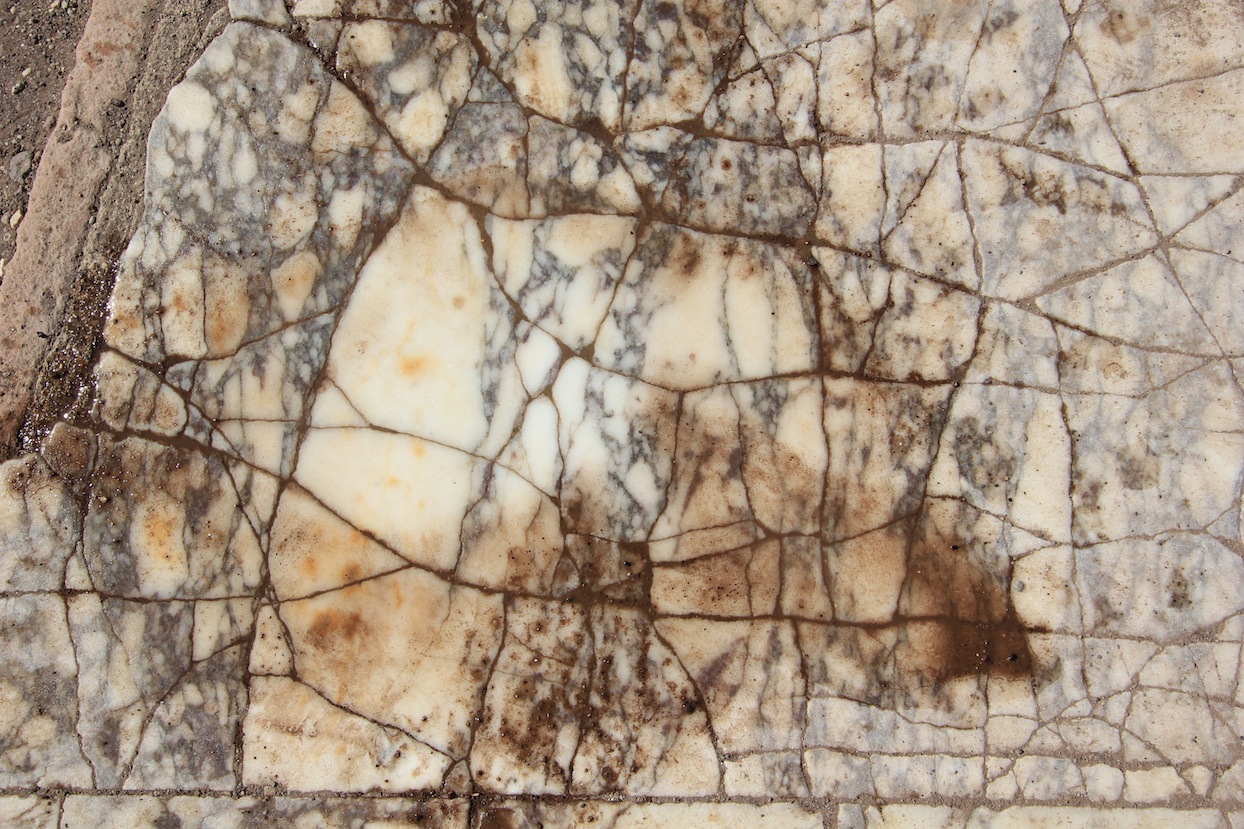
We attempted to tail an English-speaking tour group to find out as much as we could. Their guide splashed water on the pavement to reveal beautifully veined white marble. Marble sidewalks! #wow


Climbing Palatine Hill was hot work. Thankfully, the Romans built beautiful little public fountains everywhere. Many of them exist to this day, providing cool relief and drinkable water for overheated tourists.


We also sought shade under the many olive trees that dotted the hill. It was my first time to see them.


Palatine Hill encompasses both private homes and public spaces. The Stadium is one of the latter.


With just a little huffing and puffing, you get expansive views over Rome. Not just the Rome of today...


... but also the Rome of yesterday.


One of the most evocative and well-preserved spaces was the Casa delle Vestali, or the House of the Vestal Virgins. 


The Vestals were priestesses of Vesta, the Roman goddess of the hearth. They lived their whole lives as virgins, tending a sacred flame that could never go out. I loved Greek and Roman mythology growing up, so being in this space was a huge thrill for me.


For my ex-debater husband, it was a special experience to walk through the place where debate itself was born. By the way, the Forum was also the birthplace of Senate. So maybe I should've put aside my heady imaginings for a second to spit on its steps. This is for Enrile! And for Bong Revilla! And—PTOOOIE! Take that for Lito Lapid!


Seeing the Temple of Saturn looming over us was like coming face to face with a giant hand that had been held up to signal end of our visit. In the rays of the setting sun, what's left of the temple regains some of its former grandeur.


Even just a fraction of a corner of a single pillar is as big as I am.


Like this fallen chunk of temple, so many forgotten fragments of art and architecture are scattered around the ruins.


Each piece makes you ache to see things as they once were. Your mind begins to work to fill in the gaps, to somehow piece together the clues that time has left behind.


 To me this was the best thing about Palatine Hill: the fuel it pours into your imagination.


You really do feel like you're walking through a city. And what a beautiful, vibrant city it must have been in its day.


While its bustle and noise have been silenced, the beauty is still there, just... different.


Looking at the fragments that remain, such as in this temple, was like looking through cracks in time. 


I simply wished I could fall through those cracks. But all I can really do is stay on the outside, looking in. And I promise, I will always keep looking.

Monday, October 3, 2011

Night at the Musei

Just for peak season this year (Easter till early fall), the Vatican Museums opened their doors to the public on Friday nights. What used to be a very expensive privilege became a brilliant way for Marlon and I to beat the debilitating daytime heat and experience the Museums in an unusual way.


So I signed us up for a two-hour night tour of the highlights with an official Musei Vaticani guide. At €24, tickets from the Musei Vaticani website itself were the cheapest ones around. We were lucky to nab tickets only days before our visit.


Our official Vatican guide, Alexandra, was not only extremely knowledgeable and thorough, she also had amazing voluminous hair despite looking rather dead on her feet at 10pm. 


The Musei Vaticani house the vast art collection of the Catholic Church, a treasure trove that's been amassed over centuries.


The magnitude of the collection is mind-boggling in itself. The Museum's various galleries (only some of which are open at night) hold everything from ancient sculptures and priceless paintings, to more unusual things like maps and tapestries. 


Not all the art was centuries old. We only just breezed through the contemporary section, but I glimpsed large-scale works by the likes of Dali and Matisse, among many others. 


If you think the art is overwhelming, the decoration and ornamentation of the galleries themselves will make your head spin. By the end of the evening, I literally felt like my eyeballs were going to pop out (it's a very... interesting feeling). There is art in every possible nook and cranny, masterpieces everywhere from floor...


... to ceiling.


My friend Jec asked, "Is it more mind-boggling than Versailles?" I snorted. The Vatican Museums make Versailles look positively minimalist.

And yes, I had to wrestle with that a bit. After my very emotional afternoon at St. Peter's, thinking about the value of the art and—oh, you know this one—how much good it can do for the suffering of the world brought me crashing down. 

I know any of us in such a position to amass all these these treasures would keep them for as long as we possibly could. But this is an all too human instinct from a Church that professes to be divine. I wonder if a Musei Vaticani auction is something we will ever see in our lifetime. 

Since they are not exactly easy to sell, the masterpieces that are fixed to the buildings themselves are somewhat easier to think about. 


These are some of the Vatican Museums' greatest treasures: ceilings and walls adorned with frescoes by Raphael.


I was glad to have my wide-angle lens, but these pictures cannot even come close to doing these ceilings justice.


How Raphael brought theology, history and even mathematics and philosophy together in his art was simply genius.


At the point where my eyeballs were about to fall out of their sockets, we entered the world's most famous chapel with the world's most famous ceiling. I managed to snap this photo before I saw the sign forbidding photography. 


It's just as well that photography is not allowed; sometimes we forget to experience things with our own eyes, and not through a viewfinder or lens.

So I just threw my head back and stayed that way, eyes glued to the ceiling, for about 20 whole minutes. I tried to drink in as many details as I could. I simply didn't want to forget. And I don't think I ever will.